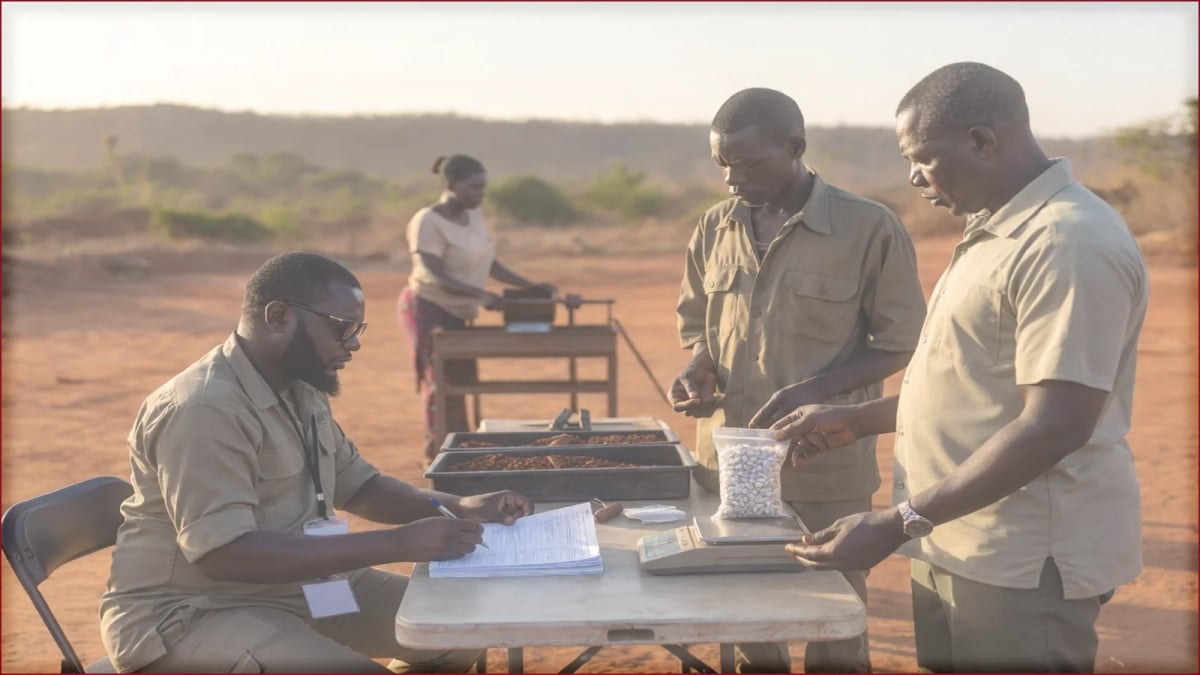
Sourcing and trade support for a mining cooperative
A small-scale mining cooperative sought to formalise its precious-metals production for institutional trade. The Project Office structured a sourcing and assaying process with chain-of-custody documentation and responsible-sourcing advisory to support formalisation.
Project Profile
Sector: Artisanal and small-scale mining cooperative — precious-metals trade facilitation Scope: End-to-end sourcing support, field assaying, chain-of-custody documentation, and institutional trade facilitation Geography: Western Region, Ghana — with cross-border facilitation into Togo Engagement Type: Structured multi-stage advisory and facilitation mandate
The Specification Challenge
Artisanal and small-scale mining cooperatives operate at the intersection of significant production capacity and institutional-grade compliance requirements — a gap that consistently prevents legitimate producers from accessing premium offtake arrangements.
This cooperative presented a well-organised operation with consistent production volumes, but lacked the documented process infrastructure that institutional buyers — refineries, licensed dealers, and regulated financial institutions — require before any trade relationship can be formalised. Provenance records were incomplete. Assay methodology was informal, relying on field estimates rather than calibrated documentation. Chain-of-custody controls between extraction point and point of sale had no audit trail.
The cooperative’s management understood the value of institutional access. What they needed was a disciplined facilitation partner who could build the documentation architecture around their existing operation — without disrupting production continuity.
Approach
Kronix Metals deployed a structured facilitation engagement sequenced across three phases.
Phase one — Baseline documentation. Field specialists conducted a full review of the cooperative’s extraction and collection processes, establishing baseline provenance records at site level. Every handover point was mapped and documented, creating the audit trail the operation had previously lacked.
Phase two — Assaying and grading. Calibrated assaying was introduced at point of aggregation, producing formal assay certificates for each consignment. This replaced informal estimation with specification-grade verification — the minimum standard that institutional counterparties require before trade terms can be agreed.
Phase three — Trade facilitation. With documentation and assay records in place, Kronix Metals introduced the cooperative to its institutional network and facilitated structured offtake engagement. Trade documentation, responsible-sourcing declarations, and chain-of-custody records were prepared to the standard expected by licensed refineries and regulated buyers operating within the Ghana and Togo corridor.
Throughout the engagement, compliance framing aligned with responsible-sourcing principles applicable to artisanal production — ensuring the cooperative’s output carried the documentation weight necessary for institutional acceptance.
Outcome
The cooperative moved from informal, documentation-light trade to a structured, auditable supply chain within a single engagement cycle. Assay records established clear, verifiable grading for each consignment. Chain-of-custody documentation satisfied the due-diligence requirements of institutional counterparties, enabling formal offtake relationships that had previously been inaccessible. The cooperative’s management gained the internal capacity to maintain documentation discipline on an ongoing basis — reducing dependency on ad hoc facilitation for routine consignments.
What This Project Demonstrates
Artisanal and small-scale mining cooperatives across Ghana and Togo represent a substantial portion of precious-metals production — yet a significant share of that production fails to reach institutional markets because documentation infrastructure has not been built around legitimate operations.
The limiting factor is rarely production quality. It is process architecture: provenance records, calibrated assaying, chain-of-custody controls, and responsible-sourcing declarations assembled to the standard institutional buyers require.
Kronix Metals exists precisely for this work — translating production capacity into institutional-grade supply through the sourcing discipline that makes every handover documentable, every consignment verifiable, and every trade relationship defensible.