
Assaying & Quality Verification
Independent quality verification and assaying services for precious metals, providing documentation at each stage of the chain-of-custody process.
When an institution searches for how gold is assayed, what they are really asking is how fineness becomes evidence rather than a claim. Kronix Metals provides independent assaying and quality verification for institutional counterparties — banks, refineries, investors, export houses, and mining cooperatives — within Ghana’s GoldBod-regulated framework, since 1992. Arrange an assay — or discuss a supply partnership: +233 27 000 0844 (Togo / Lomé: +228 96 86 86 75). Institutional partners only.
How Gold Is Assayed — and Why It Is the First Step
Assaying determines the purity, composition, and weight of gold, silver, or platinum-group material analytically — by fire assay, XRF, or a combination protocol — and, critically, documents the result against a registered parcel reference. Until that is done, a fineness is asserted, not known. Every credible custody change, financing event, or export declaration rests on this analytical foundation, which is why institutions specify it before, not after, the transaction proceeds.
What is Assaying & Quality Verification?
Assaying and quality verification is the analytical discipline at the centre of every credible precious-metals transaction. It is the process by which the purity, composition, and weight of gold, silver, or platinum-group material is independently determined — and, critically, documented — before a change of custody, financing event, or export declaration proceeds. Without it, a transaction rests on assertion rather than evidence.
Kronix Metals provides independent quality verification as a structured service for institutional counterparties who require documented, reproducible analytical results tied to specific parcel references. Banks advancing commodity-backed facilities, refineries receiving raw material, institutional investors establishing position, and mining cooperatives preparing offtake consignments all specify this service for the same reason: the analysis must be defensible, the documentation must travel with the metal, and the result must carry the signature of a process rather than the word of an individual.
When to Specify Assaying & Quality Verification
Quality verification is non-negotiable at any point where a precious-metals parcel changes ownership, enters a secured facility, or is presented to a counterparty as collateral or inventory. In practice, this spans a range of institutional scenarios across Ghana and Togo — from cooperative-level dore consolidation ahead of refinery delivery, to bank-level audit verification of existing holdings, to pre-export confirmation required under responsible-sourcing frameworks.
The service is also routinely specified mid-chain, where a parcel has passed through multiple handling stages and an independent verification resets the evidentiary record before the next counterparty receives it. Any institution managing reputational or regulatory exposure around chain-of-custody integrity will specify independent assaying at this juncture rather than rely on documentation inherited from earlier in the chain.
Methodology — The Kronix Metals Specialist Approach
-
Parcel Registration & Chain-of-Custody Opening. Each consignment is formally registered against a unique parcel reference before any analytical work begins. Custody status, provenance declarations, and counterparty identifiers are recorded at intake, establishing the documentary baseline.
-
Physical Condition & Segregation Assessment. Specialists conduct a physical review of the material — form factor, visible inclusions, weight reconciliation — to confirm the parcel matches its accompanying documentation and to determine the appropriate analytical method.
-
Sample Preparation & Method Selection. Representative sampling is conducted under controlled conditions. Method selection — fire assay, X-ray fluorescence, or a combination protocol — is determined by material type, purity range, and the precision threshold required by the commissioning party.
-
Analysis & Results Verification. Analytical results are reviewed internally against method tolerances before any result is issued. Where results fall outside expected parameters, a second determination is conducted and both readings are reported with full methodology notes.
-
Certificate Issuance & Chain-of-Custody Closing. A formal assay certificate is issued, cross-referenced to the parcel registration record. The certificate documents methodology, results, sample weight, analyst sign-off, and date — providing the evidentiary record that travels with the metal through subsequent custody stages.
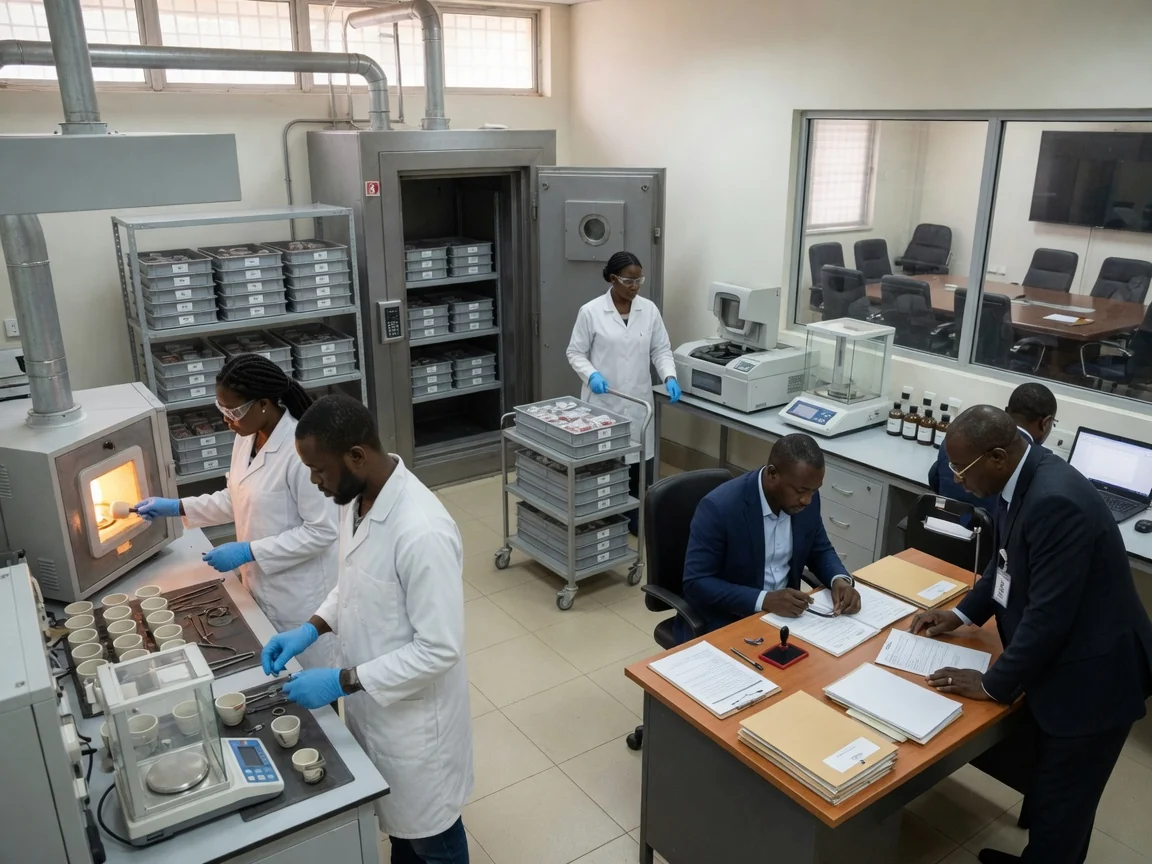

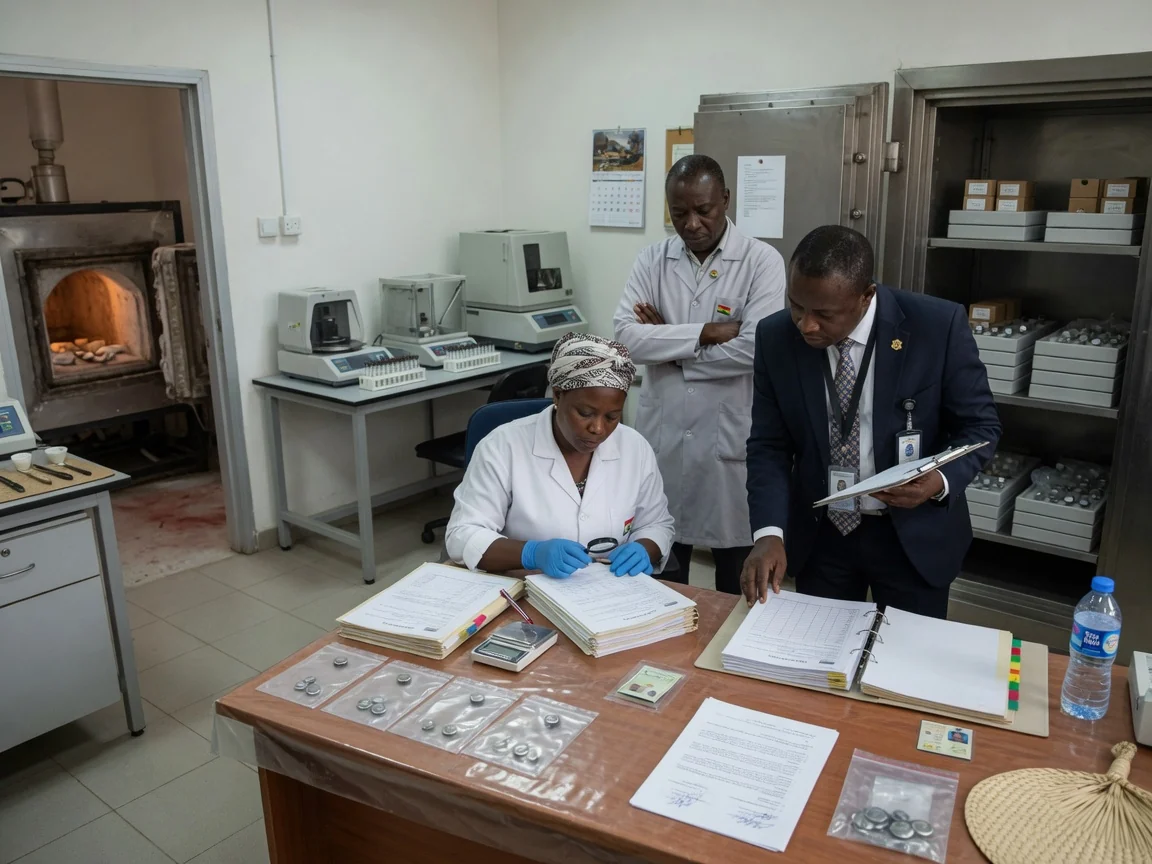
Standards & Process Rigour
- Independent sampling protocols aligned to institutional assay-house practice standards
- Fire assay and XRF method documentation retained per parcel reference
- Chain-of-custody records maintained with full counterparty and handling-stage attribution
- Responsible-sourcing declaration linkage — provenance documentation reviewed alongside analytical data
- Result issuance only after internal verification review — no single-analyst unconfirmed release
- Documentation formatted for acceptance by Tier-1 banking, refinery intake, and institutional audit processes
Outcomes
Commissioning parties receive a result they can present without qualification. The assay certificate is traceable to a documented process, cross-referenced to a registered parcel, and supported by retained methodology records. This is the analytical foundation that allows a transaction to proceed, a facility to be drawn, or a shipment to clear — because every counterparty in the chain holds the same evidentiary document.
Markets We Genuinely Serve
We verify supply for institutional counterparties in the United Kingdom and major European markets, across Africa, and through the Ghana–Togo (Lomé) corridor and Francophone West Africa — in English and French. We describe only the markets we actually serve; we are an institutional verification partner, not a retail testing service.
Legitimacy & Compliance
- We provide assay and quality verification within the Ghana Gold Board Act, 2025 (Act 1140) — under which GoldBod is the national assayer and the sole legal buyer, assayer, and exporter of ASM-sector gold. We operate within that framework and do not claim to be GoldBod or the national assayer, to mine, or to be a refinery
- Fineness is valued against international spot (LBMA / COMEX), never below — there is no separate “Ghana gold price”, and an offer below spot, an advance fee, or a “guaranteed” parcel is a scam signature, not a trade
- Sampling and method documentation are aligned to institutional assay-house practice; we make no claim of LBMA or ISO-17025 accreditation unless verifiably held, and no Ghana refinery is LBMA-accredited
- Institutional partners only — banks, refineries, investors, manufacturers, export houses, mining cooperatives; we do not test gold for the public
Related Services
- Due Diligence & Chain-of-Custody — documented verification at every transfer point
- Responsible Sourcing in West Africa — OECD due diligence at scale
- International Gold Trade Facilitation — certified supply to institutional buyers
- Trade Facilitation — transaction structuring across Ghana and Togo