
Secure Storage
Secure storage facilities and management for precious metals, operated under documented custody protocols and access controls.
What Is Secure Storage?
Secure storage, in the context of institutional precious-metals trade, refers to the structured holding of assayed metals under documented custody conditions — where access, movement, and handover are governed by protocol rather than convenience. It is the physical and procedural architecture that sits between a completed assay and the next stage of a transaction: settlement, delivery, transfer to a refinery, or onward trade facilitation.
For banks, licensed dealers, institutional investors, and mining cooperatives operating across Ghana and Togo, secure storage is not a passive warehouse function. It is an active chain-of-custody discipline, wherein every gram held is traceable, every access event is recorded, and every withdrawal is matched against documented authorisation. Kronix Metals designs and operates storage arrangements built to satisfy institutional scrutiny — including the documentation standards that Tier-1 counterparties and regulatory auditors require at review.
When to Specify Secure Storage
Institutions specify secure storage at the point where metals leave the sourcing or assaying stage but have not yet completed settlement or delivery. Mining cooperatives moving consolidated parcels toward a refinery counterparty require a holding environment that preserves chain-of-custody integrity across the interval. Banks and institutional investors acquiring physical holdings require documented proof of storage condition, access control, and weight reconciliation before committing to a transaction.
Secure storage is equally critical for cross-border facilitation between Ghana and Togo, where regulatory handover points demand a clear custody record at each stage of the corridor. Refineries receiving metals for processing require that the incoming parcel’s custody history be unbroken and auditable. In each of these scenarios, the absence of a rigorous storage framework introduces documentation gaps that can halt a transaction or invalidate a regulatory submission.
Methodology — The Kronix Metals Specialist Approach
-
Intake Assessment and Documentation — Upon receipt, every parcel is logged against a custody manifest. Weight, form, and condition are recorded at the point of entry, cross-referenced against the accompanying assay documentation and client authorisation records.
-
Segregated Holding Assignment — Holdings are maintained on a segregated basis, with individual client parcels identifiable at all times. Commingling is not permitted under any operational condition.
-
Access Control and Event Logging — All access events — scheduled reviews, partial withdrawals, or third-party inspections — are recorded against a timestamped access log. No movement proceeds without prior authorisation matched to the client record on file.
-
Periodic Reconciliation — Held weights and parcel conditions are reconciled on a defined schedule. Discrepancy flags are escalated immediately and documented in full before any further movement is permitted.
-
Custody Transfer and Release Protocol — Upon authorised release, outgoing parcels are re-weighed, re-documented, and matched against the original intake record before transfer to the receiving counterparty. A final chain-of-custody certificate accompanies every release.
Protocols and Operating Standards
- Documented intake-to-release custody manifest for every parcel
- Segregated holding — no commingling under any operational condition
- Timestamped access log maintained for every entry and movement event
- Reconciliation schedule aligned to client transaction timelines and regulatory review windows
- Chain-of-custody certificate issued at each handover point
- Alignment with responsible-sourcing documentation requirements across Ghana and Togo regulatory frameworks
Outcomes
Institutions that operate within a rigorous secure storage framework present clean audit trails to counterparties, regulators, and refineries. Documentation gaps — the most common cause of delayed settlements and failed regulatory submissions — are eliminated when every custody interval is governed by a written protocol. Clients receive a storage arrangement that holds up under institutional scrutiny at every stage: from initial holding through periodic review to final release and transfer.
The outcome is not simply safeguarded metal. It is a fully documented custody record that supports settlement confidence, satisfies refinery intake requirements, and demonstrates responsible-sourcing discipline to any auditing counterparty.
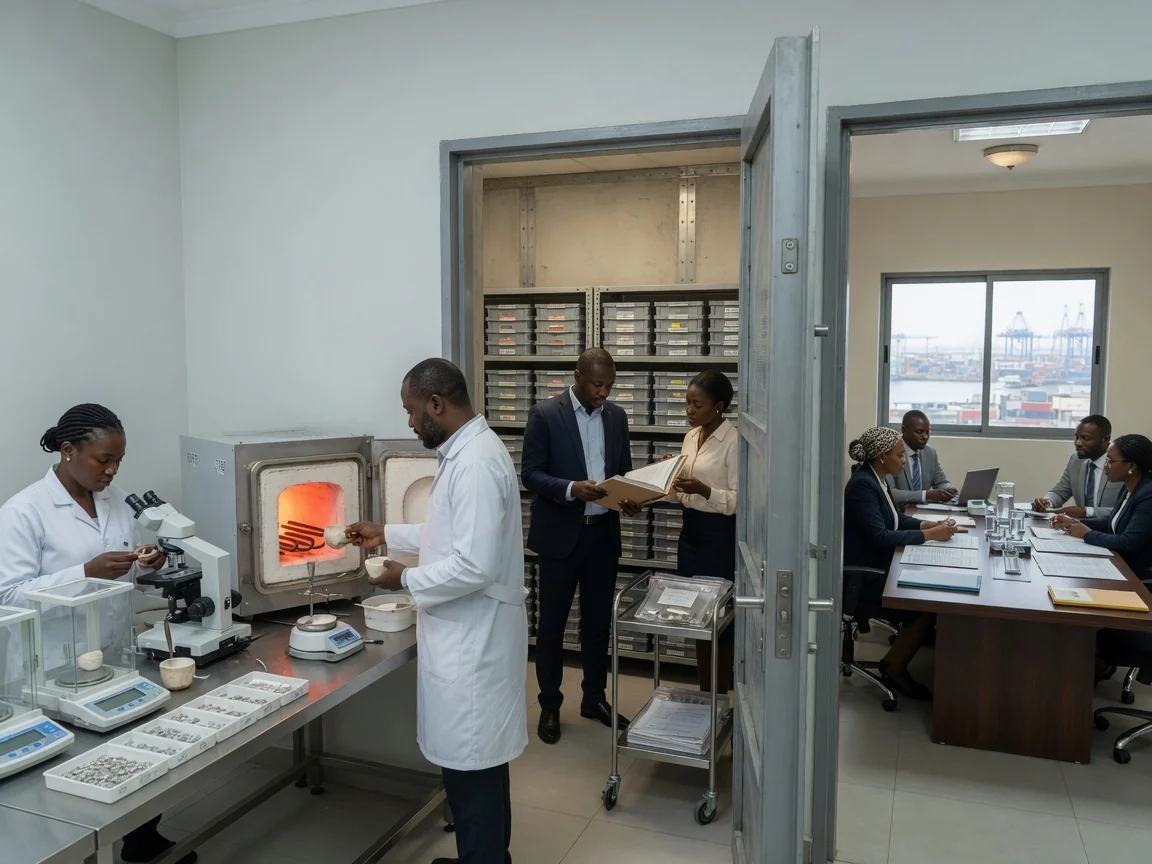

How Secure Is Institutional Gold Storage?
For institutions, secure storage is not about a stronger safe — it is about an unbroken, auditable custody record. Allocated, segregated holding means each client parcel is identifiable at all times and never commingled; a timestamped access log means every entry and movement is recorded; periodic reconciliation means held weight and condition are matched against the intake record on a defined schedule. The security an auditor cares about is documentary: a custody history that holds up at every handover from intake through release. Where stored metal is valued for settlement or onward trade, it is valued against international spot (LBMA / COMEX), never below — the same discipline that separates a legitimate custody service from a scam.
Markets We Genuinely Serve
We hold and manage allocated precious-metals storage for institutional partners — banks, licensed dealers, institutional investors, refineries, and mining cooperatives — across Ghana, the Ghana–Togo (Lomé) corridor and Francophone West Africa, serving onward buyers in the United Kingdom and major European markets and across Africa. We describe only the markets we genuinely serve; we are an institutional custody and facilitation partner, not a retail seller.
Legitimacy & Compliance
- We operate within the Ghana Gold Board Act, 2025 (Act 1140) — under which GoldBod is the sole legal buyer, assayer, and exporter of ASM-sector gold. We provide a custody and facilitation service within that framework and do not claim to be GoldBod, to mine, or to be a refinery
- Storage is allocated and segregated, with documented chain-of-custody from intake to release — aligned to responsible-sourcing documentation requirements across the Ghana and Togo regulatory frameworks
- Where stored metal is valued, it is valued against international spot, never below; no Ghana refinery is LBMA-accredited and we make no such claim
- Institutional partners only — banks, dealers, investors, refineries, mining cooperatives; we do not store or sell precious metals for the public
Related Services and Solutions
Secure storage operates as a continuous function within a broader institutional precious-metals framework. Related capabilities include Assaying and Valuation, Trade Facilitation, and Chain-of-Custody Documentation — each stage designed to connect without documentation breaks across the full Ghana and Togo corridor.
- Secure Logistics & Vaulting — sealed, insured movement between custody points
- Assaying & Quality Verification — certified fineness before holding
- Due Diligence & Chain of Custody — the unbroken custody record
- Trade Facilitation — when a holding moves to settlement
- Precious Metals Export, Ghana–Togo — the documented corridor
Discuss a Custody Partnership
Discuss a supply partnership — or request a proposal against spot: +233 27 000 0844 (Togo / Lomé: +228 96 86 86 75). Institutional partners only.